Available for hire

RJ Lopez
Builder-Operator

I build local-first agent systems I can operate, inspect, approve, and recover.

Former cleanroom field tech → self-taught Linux / agent-systems builder.

Field systems background

Before building software, I worked in cleanroom certification, field service, quality control, industrial maintenance, thermal spray, equipment troubleshooting, and audit-ready documentation. That background shapes how I build: verify the system, document the evidence, understand the failure mode, and leave a recovery path.

Best fit
Forward Deployed Engineer Agent Systems Engineer DevTools / QA / Verification Engineer Linux / local-first automation roles

This work is aimed at one problem: making AI-assisted engineering visible, reviewable, and safe enough for real operators.

7 shipped proof points 22 direct external PR merges 1 formal QA report Linux-first local-first Android/Kotlin Tauri Python Tailscale YubiKey

Operating principle

I do not treat AI output as truth. I treat it as a claim. A claim has to survive verification: deterministic scoring, local execution, repeatable tests, receipts, logs, human approval, and recovery paths.

VERITAS is the rule behind the work: local-first systems, deterministic validation, no unnecessary network dependency, human approval at irreversible steps, and documented failure modes.

Open-source proof

Twenty-two verified direct external PR merges outside my own repos. The newest are a non-executing exact-action review skill in GitHub's Awesome Copilot collection and an InvalidInput repair in freedesktop-rs nmrs. The strongest architectural proof remains a separate Hermes Agent fallback-auth fix that survived upstream restructuring and landed in main through a maintainer reapply, with my authorship preserved on commit 998e35313. That maintainer-authored PR is not counted as one of the 22 direct PR merges.

The ledger below also covers AgentDoctor, Drift, Trail of Bits Dylint, Codex Desktop Linux, Kaoto forms, ShellCheck, Amber, Annotorious, Ansvisor, Karakeep, harehare/mq, two MCP directory merges, and three Trust Lab catalog/watchlist merges. A separate open Hermes maintainer PR explicitly credits my earlier login-shell PATH diagnosis and is excluded from the direct merged-PR count.

NEW
Public zero-signup lab · v0.1.0

VERITAS Omega Agent Trust Lab — A verdict is not authority

Blindly judge six plausible agent decisions, then inspect what recomputation, exact action binding, replay protection, independence accounting, evidence identity, and fail-closed monitoring reveal.

THREE CLEAN / THREE TAMPERED / ANSWERS HIDDEN UNTIL LABELS ARE SEALED LOCALLY

The public lab turns VERITAS's proof boundary into a working browser challenge. Labels stay on-device unless a participant explicitly downloads them or contributes a public GitHub issue. A separate explorable view exposes the deterministic packet, reason codes, and stop condition for each attack.

What it proves

A complete public-product loop: primary-source market research, a shared browser/Node assurance engine, 62 passing tests, CI-gated GitHub Pages deployment, downloadable verification evidence, an opt-in route for third-party blind labels, and a public help-wanted challenge to independently reproduce or break the checker. Protocol v2 records 10/50 scoped outside actions from 10 distinct validators, with 40 remaining, 7/10 technical events, zero independent verifier runs, and $0 settled revenue.

Commercial test

Two $750 founding pilot slots: one consequential agent workflow, up to five operations, six tailored hostile cases, a replayable packet, residual-risk register, and findings walkthrough.

Boundary

The ten outside actions validate only their recorded scopes: three catalog or watchlist decisions, one independent technical reproduction, three accepted integrations, and three substantive external reviews. One qualifying review is an unfavorable root-cause rejection, not acceptance; the RCL owner review confirmed a pinned corpus contract but is not an independent VERITAS verifier run. A separate AgentTrust catalog decline remains a zero-weight negative outcome. They do not establish broad adoption, product efficacy, endorsement, certification, or payment. The product thesis remains VERITAS INCONCLUSIVE; the lab is not an audit, factual-truth engine, or execution authority.

External reproduction impact

The Agent Security Harness maintainer independently verified the pinned 11/11 RCL reproduction and later merged PR #323, which permanently credits that scoped reproduction in the upstream README. The broader sweep's DOI, guard, count, citation, and metadata findings remain the maintainer's work.
01

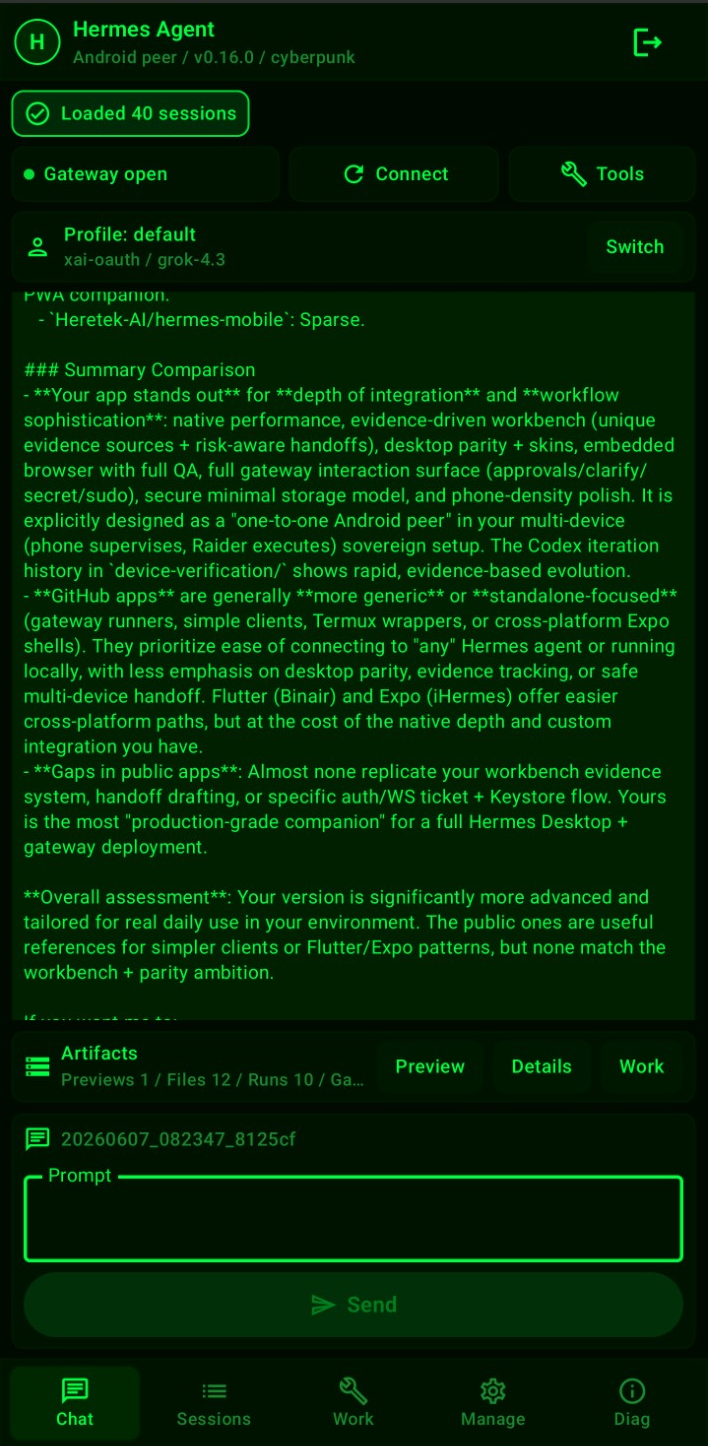
Hermes Agent Mobile Companion — Proof I can build around real agent infrastructure

Phone-first Android control surface for a Hermes Agent desktop/gateway setup.

I did not create Hermes Agent. Hermes Agent is the upstream agent/gateway/tooling layer. My work builds a mobile companion/control surface around daily operation: sessions, tools, artifacts, gateway state, approvals, profiles, and handoff back to the desktop.

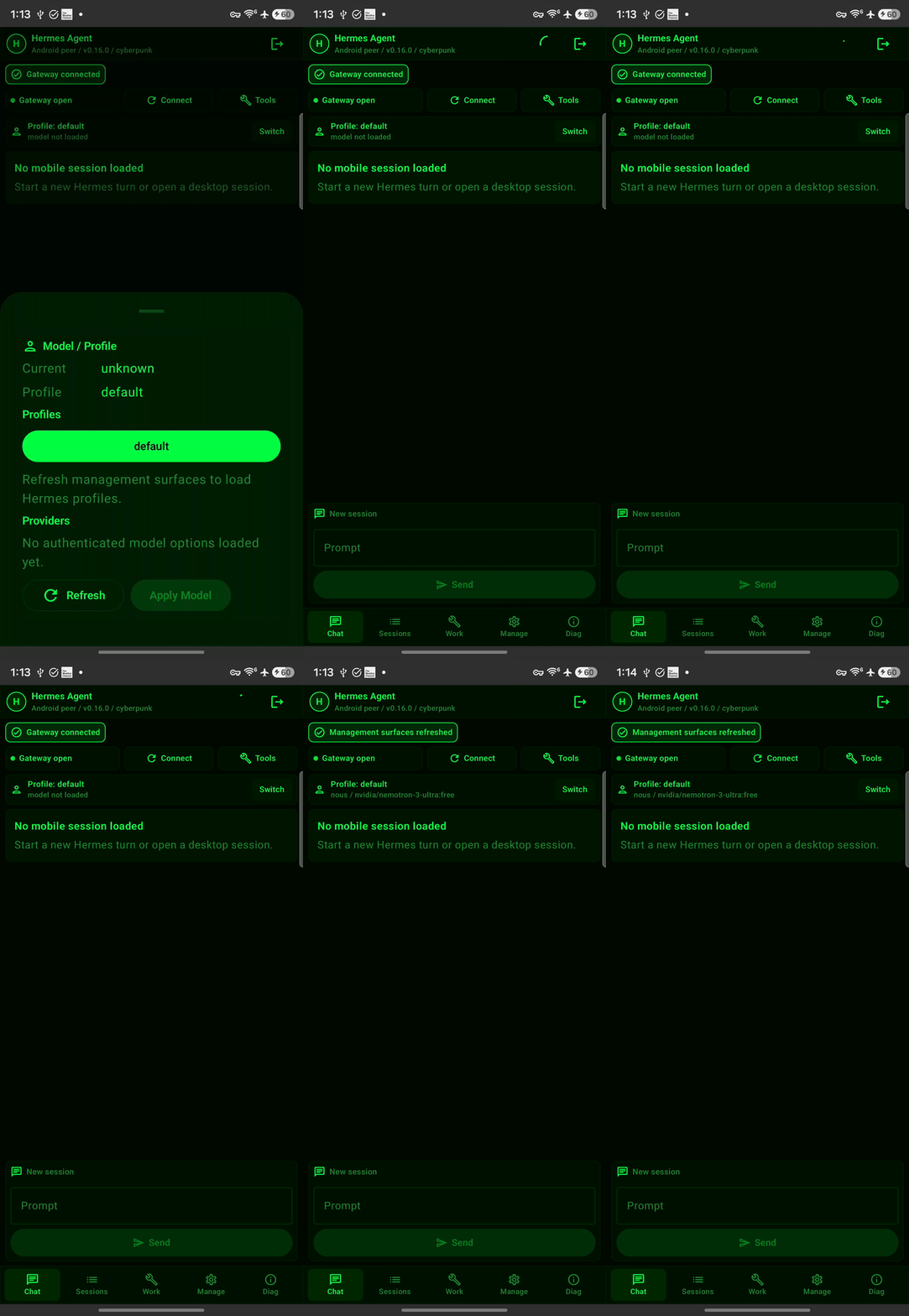
Hermes Agent Mobile Companion screenshot preview
Android card surface
Hermes Agent Mobile Companion live demo
Live demo

What it proves

Android/mobile product execution, agent workflow design, gateway supervision, tool/action UX, artifact review, local-first thinking, and building useful surfaces around an existing agent platform instead of treating agents as chat boxes.

Failure mode

The phone should supervise and approve; the desktop/gateway should execute. High-risk actions must expose state, intent, artifacts, and recovery paths before execution.

02

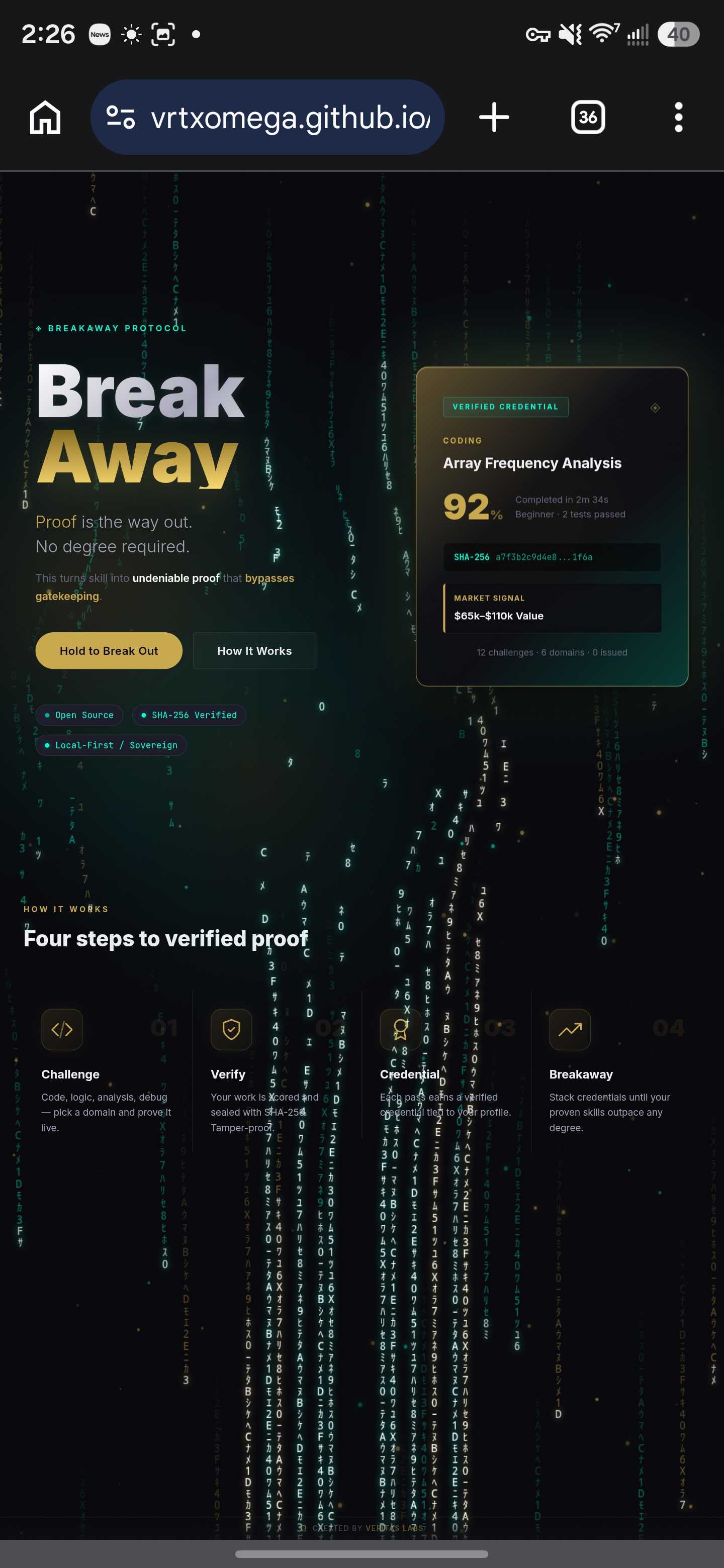
Breakaway Protocol — Proof I can ship

Zero-dependency credential engine, deterministic scoring, SHA-256 sealed, 2nd place VibeJam

Breakaway Protocol credential showing SHA-256 hash
SHA-256 sealed VibeJam #2

What it proves

public product instinct, frontend polish, deterministic credentialing, and a clean story strangers can understand quickly.

Failure mode

handles tampering via SHA-256 seal — any edit invalidates hash

03

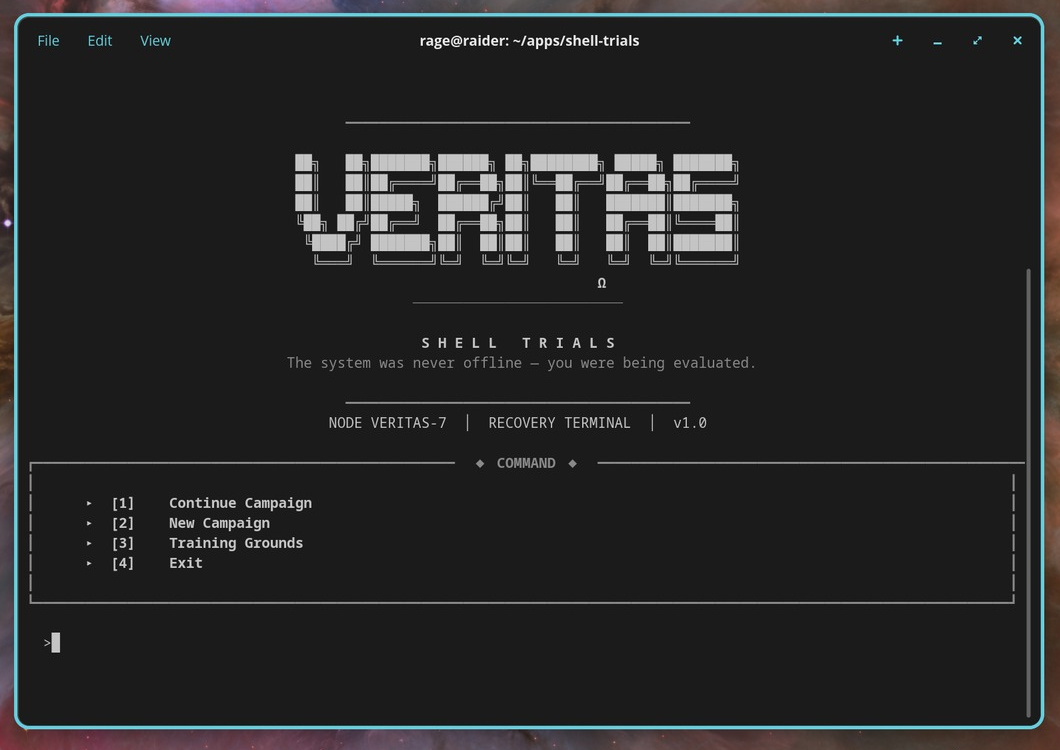
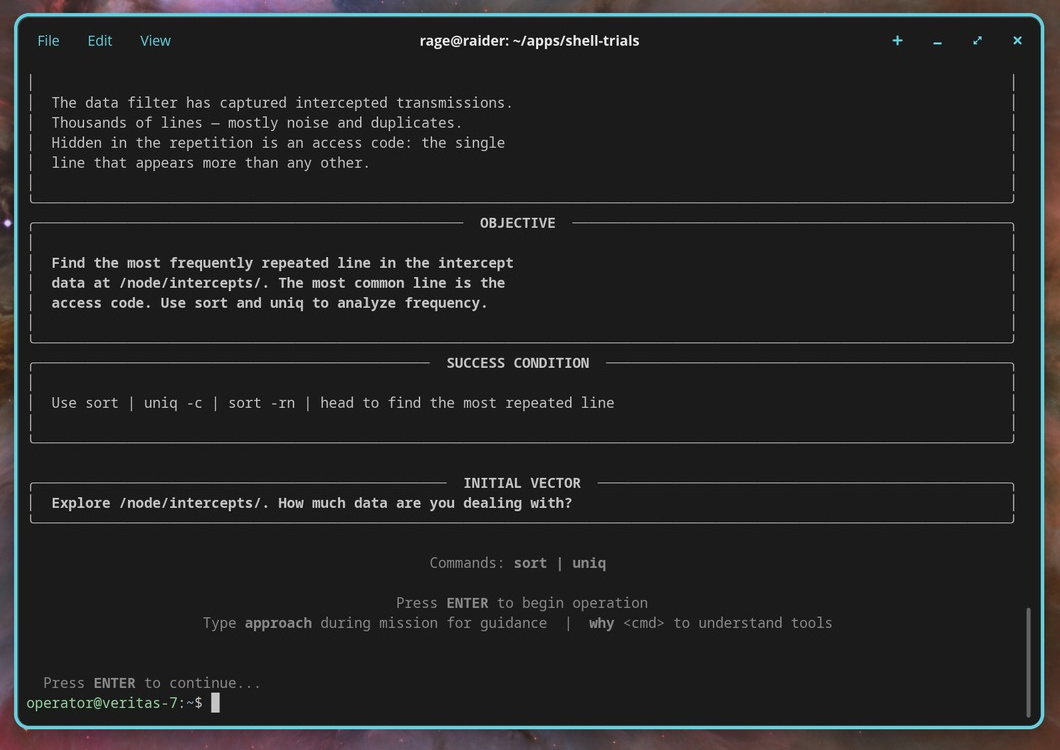
Shell Trials — Proof I can teach systems

Terminal RPG that teaches Linux by doing, not reading

Shell Trials main menu
Shell Trials mission screen

What it proves

Python, simulated shell behavior, educational design, command-line fluency, and learning deeply enough to teach it.

Failure mode

invalid commands don't crash — parser guides with why <cmd>

04

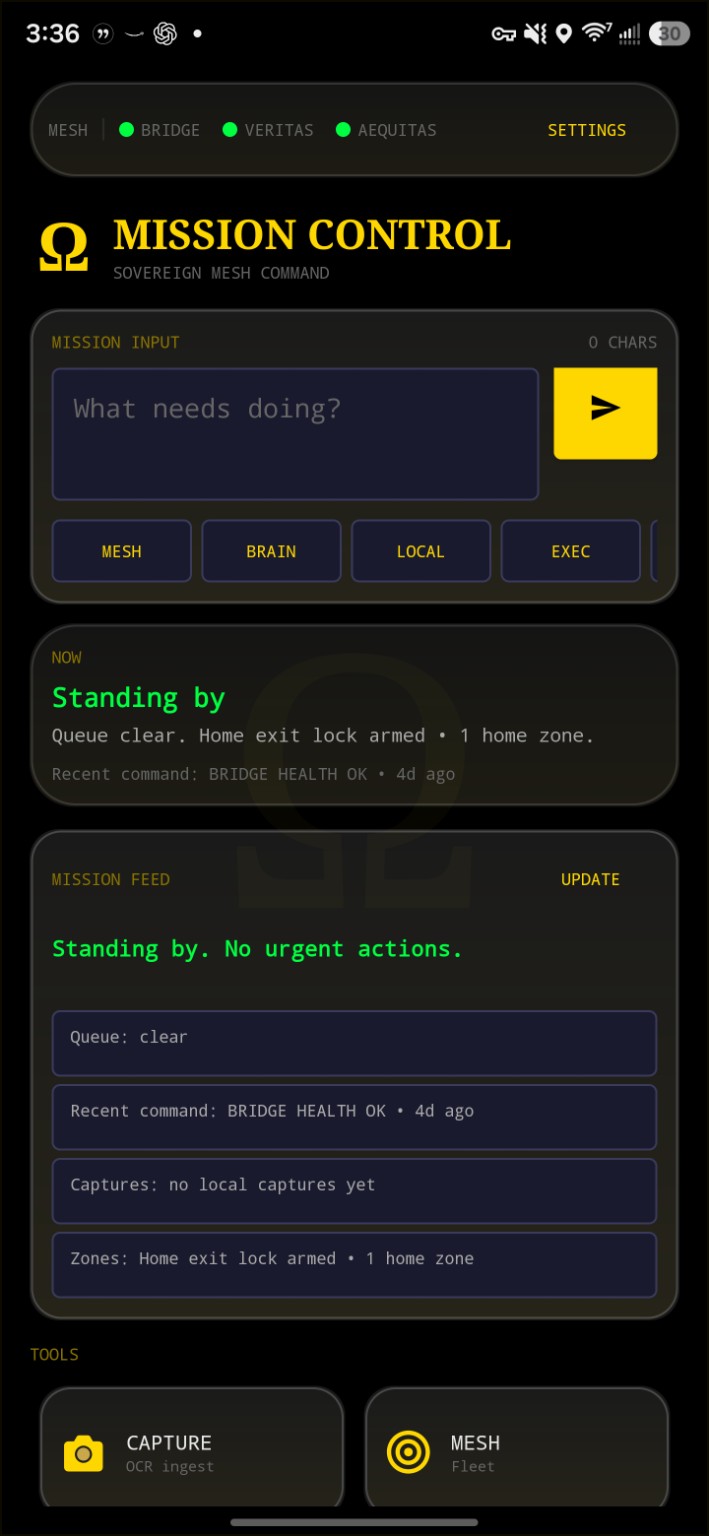
Omega SMC — Proof I can operate infrastructure

Android mesh command center for a private Tailscale operator network

Omega SMC Mission Control Android screen showing healthy mesh status and mission feed
actual phone-side view mesh healthy mission receipts

What it proves

Android/Kotlin, Room, Tailscale-aware infrastructure, local AI fallback, secure execution design, audit logging, and real operational ownership.

Failure mode

high-risk actions use proposal, preview, and queue semantics instead of arbitrary shell execution; phone-side mesh checks prevent desktop-only false confidence.

05

coders-bible-desktop — Proof I can package

Offline Tauri knowledge engine with 67,000+ fragments, zero cloud dependency

67k+
fragments
0
API calls
100%
offline
Tauri Rust SQLite local-first

What it proves

desktop packaging, local-first architecture, search UX, offline distribution, and deterministic no-network constraints.

Failure mode

works fully offline, no API keys to leak

06

YubiKey/FIDO2 + Tailscale Mesh — Proof I understand failure modes

Hardened Linux auth and recovery setup with tailnet-only SSH and closed inbound ports

# operator mesh — public inbound closed
 ┌─────────────┐   YubiKey + PAM    ┌──────────────┐
 │   laptop    │ ─────────────────► │ tailscale0   │
 │  recovery   │  ssh via tailnet   │  100.x.y.z   │
 └──────┬──────┘                    └──────┬───────┘
        │                                  │
        │  MagicDNS workflow                 │
        │  ufw: deny incoming                │
        │                                  ▼
        │                           ┌──────────────┐
        └──────────────────────────►│  Linux host  │
                                    │  FIDO2 login │
                                    │  SSH: tailnet│
                                    │  no public SSH│
                                    └──────────────┘

What it proves

PAM, Linux authentication, ufw, SSH hardening, Tailscale, MagicDNS workflows, recovery planning, and documentation.

Failure mode

no public SSH exposure; recovery paths rely on known tailnet devices and hardware-backed auth instead of broad password fallback.

Proof of Work — upstream & QA

External evidence outside my own repos: direct merged upstream pull requests, separately preserved upstream authorship, accepted work in tools people use, and a formal beta QA deliverable for agent memory.

Live GitHub readback now shows 22 direct merged external PRs outside my own repos: 3 Codex Desktop Linux merges, 5 directory/catalog/watchlist merges, 13 maintainer-facing fixes or integrations, and 1 harehare/mq language parser fix. Hermes Agent maintainer-reapplied authorship and the RCL reproduction credit are documented separately rather than being converted into direct-PR counts. The difference is not volume — it is gating overlap, issue fit, and review-readiness before opening.

Current external merge ledger

Preserved authorship · separate
Codex Desktop Linux · 3
  • #495 — Linux feature parity for Codex 26.609
  • #302 — Wayland GPU rendering profile
  • #236 — GitHub CLI auth workaround docs
Maintainer fixes / integrations · 13
Directory / catalog proof · 5
Language/tooling · 1
OS-1

Hermes Agent — upstream-salvaged contribution

NousResearch/hermes-agent · maintainer PR #65682 · merged into main

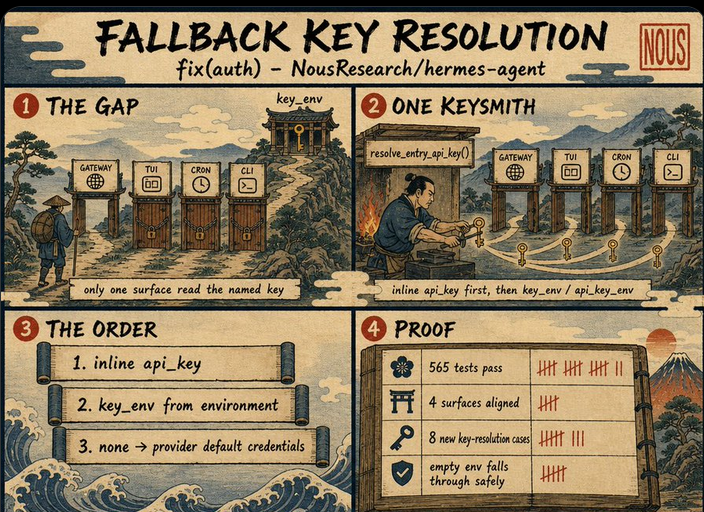
Fallback Key Resolution infographic for the merged Hermes Agent authentication fix
Infographic created for the merged fix: the gap, the shared resolver, the precedence order, and the verification proof.
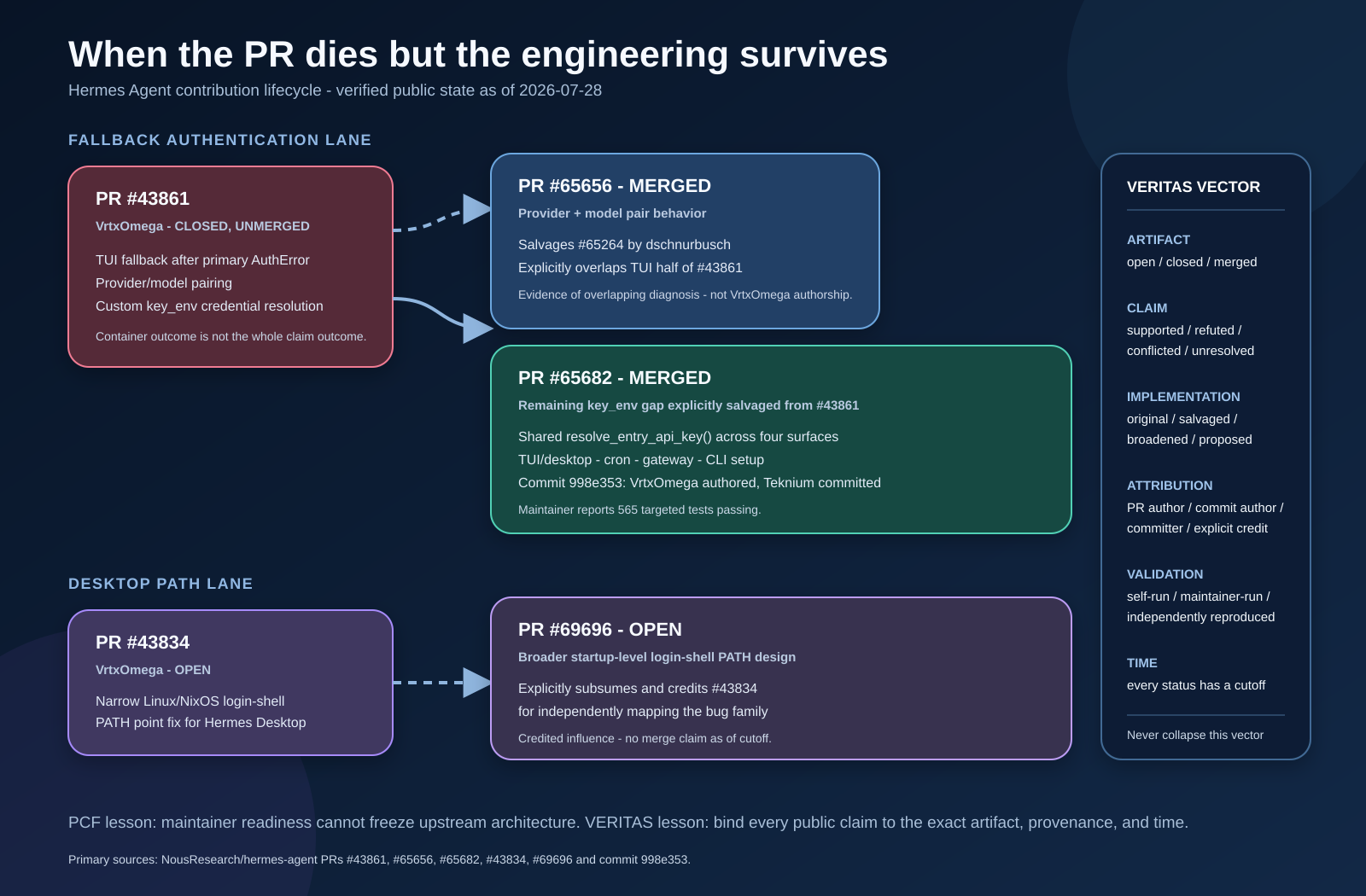
VERITAS contribution lifecycle graph separating the original Hermes PR, maintainer salvage, preserved commit authorship, and open credited PATH work
VERITAS lifecycle view: PR outcome, surviving claim fragments, upstream incorporation, authorship, and present status remain separate evidence fields.
What survived

The original PR did not merge. The engineering did.

My original PR #43861 predated a major fallback restructuring and could no longer be cherry-picked. Maintainer Teknium surgically reapplied the remaining per-entry key_env gap, preserved my authorship, centralized it in resolve_entry_api_key(), and used it across TUI, cron, gateway, and CLI setup.

Proof

565/565
targeted tests
4
surfaces aligned
8
new key cases
7
files changed

What it proves

I can find a real cross-surface auth defect in a fast-moving codebase, explain the failure mode, and produce engineering strong enough to survive architectural drift and maintainer review.

Evidence

Merged PR #65682

Authored commit 998e35313

Formal contribution-lifecycle case study (PDF)

The report separates artifact status, claim fragments, implementation source, commit authorship, and current upstream state. It is an author-side evidence assessment—not an independent audit or Nous Research endorsement.

Scope boundary: this card claims the per-entry key_env resolution work salvaged into #65682, not authorship of the separate provider/model restructuring.

Second Hermes signal · open, not counted as merged

Teknium's broader open PR #69696 resolves login-shell PATH once for the Hermes Desktop backend and explicitly subsumes and credits my earlier PR #43834 for independently mapping that GUI/login-shell bug family. After another upstream startup refactor, the August 6 refresh preserved PATH resolution before backend selection and spawn, passed 12/12 shell-path tests, and returned required CI to green.

OS-2

ShellCheck — merged upstream contribution

koalaman/shellcheck · PR #3484 · merged into master

Narrow fix for SC2030/SC2031 false positives on the special shell variable $_ / discard variable _. Accepted into a respected developer-tooling project with Docker-backed Cabal tests and a one-file diff.

What it proves

Real upstream contribution to a widely used static-analysis tool, not a fork-only patch.

OS-3

Amber — merged upstream contribution

amber-lang/amber · PR #1116 · merged into staging

ShellCheck-related generated-shell output fix: add -r to shell version prelude reads (SC2162). Scoped through ShellCheck findings and a Premature Contribution Firewall review-readiness workflow so the PR stayed narrow, validated, and reviewable.

What it proves

Maintainer-friendly open-source discipline: one warning class, reproducible before/after ShellCheck output, no drive-by cleanup.

OS-4

Ansvisor — merged upstream contributions

ansvisor/ansvisor · 2 merged PRs into main · same-day 2026-06-11

Platform-grouping fixes for an AI visibility product: group prompt-result buckets by platform only so provider model slug drift does not split one logical platform into duplicate rows. Extracted grouping helpers with Vitest coverage for slug drift and distinct-platform separation.

  • PR #235 — insights dashboard Prompt Results by Topic · closes #231
  • PR #237 — prompt detail page grouping · closes #236 · maintainer-invited follow-up from #235
TypeScript Vitest Next.js

What it proves

Two accepted external contributions in one day: issue-linked fixes, test-backed grouping logic on both insights and prompt-detail surfaces, and CI validation (format, lint, typecheck) before merge.

OS-5

Annotorious — merged upstream contribution

annotorious/annotorious · PR #610 · merged into main · closes #595

OpenSeadragon annotation fix: expose polygonSimplificationTolerance on init options so callers can preserve full polygon geometry (0) while the default tolerance keeps rendering self-protection. Maintainer pointed at the exact PixiLayer path; Vitest covers polygon and multipolygon behavior.

TypeScript Vitest OpenSeadragon

What it proves

Maintainer-invited configurability on a named code path: implement the suggested option, keep the default unchanged, test both polygon types — merged with maintainer thanks.

OS-6

codex-desktop-linux — accepted external contributions

Unofficial Linux port of Codex Desktop · 3 merged PRs

Accepted external contributions improving the Linux / Pop!_OS 24.04 experience, packaging/install flow, and app-bundle feature parity for a tool I use daily — not just my own repos.

  • PR #495 — Linux feature parity for the Codex 26.609 app bundle
  • PR #302 — Wayland GPU rendering profile for COSMIC / Pop!_OS
  • PR #236 — GitHub CLI auth workaround docs for isolated XDG / DBus keyring paths
Pop!_OS 24.04 Wayland packaging

What it proves

Work accepted into an external desktop tool with real users, focused on Linux compatibility, feature parity, and operator-facing install/docs friction.

OS-7

Sibyl Memory Plugin — formal beta QA deliverable

Local-first agent memory evaluation · isolated sandbox · 2026-06-11

Formal beta test deliverable covering install/setup, local storage, touched configs, data movement, Hermes integration, memory behavior, trust/control, bugs, and recommendations. Production Hermes, Omega Brain, and host memory were not exposed.

11/11
Hermes chats
0
net syscalls
FREE
cap verified
1
bug found

Key results

  • Isolated sandbox; production stacks not exposed
  • Memory operations verified local — 0 network syscalls on remember/search (strace)
  • FREE tier cap enforcement verified; status/dashboard crash once DB exceeds cap (real bug)
  • Recommendations: sandbox docs, DB path documentation, migrate warnings, read-only CLI memory commands

Failure mode

Dual DB paths (CLI vs Hermes adapter) do not auto-unify; documented as a trust/control finding, not silently assumed.

Origin

The Clause of Chaos

Mid-January 2026

In December 2025 I herniated my back at work. In mid-January 2026, stuck at home trying to make money and stay useful, I started writing fiction designed to teach frontier models how to reason through verification instead of vibes.

The first real character was Arthur Keane, a Practical Magic Commission inspector walking into a floating castle and immediately checking landing-zone markings, containment leakage, load-bearing structures, documentation, and emergency descent systems. The wizard assures him everything is fine. Arthur's answer is the whole point:

"I'll need to verify compliance myself."

That became my operating principle: AI output is not truth until it survives verification. Everything I have built since follows that line.

How it shows up

Breakaway uses deterministic scoring and SHA-256 sealed proof.

Shell Trials validates commands inside a simulated learning environment.

Omega SMC records operation receipts instead of trusting invisible state.

coders-bible stays local, offline, and inspectable.

YubiKey/Tailscale turns recovery paths into part of the system, not an afterthought.

Light Bridge / VERITAS Wallet v3.7

Hardware custody architecture concept, not presented as a shipped product.

Included as future architecture: dual-domain isolation, IR bridge thinking, e-ink verification, and hardwired confirmation controls. The value is the threat model and physical-isolation discipline, while the shipped proof points stay focused on working software and infrastructure I personally operate.

Interactive schematic
Click IR beams, hover photovoltaic cells, and test the kinetic gate.
Open full view
ASCII fallback sketch
====================================== PHYSICAL ENCLOSURE (TITANIUM CHASSIS) ======================================
|                                                                                                                 |
|   +---------------------------------------+               +---------------------------------------+             |
|   |            COMMAND DOMAIN             |               |            CUSTODY DOMAIN             |             |
|   |         (External Interface)          |               |             (Secure Element)          |             |
|   |                                       |               |                                       |             |
|   |  +---------------------------------+  |               |  +---------------------------------+  |             |
|   |  | Primary Power Input / Regulators |  |               |  | Isolated Photovoltaic Cell Array|  |             |
|   |  +---------------------------------+  |               |  +---------------------------------+  |             |
|   |                  |                    |               |                  ^                    |             |
|   |                  v                    |               |                  |                    |             |
|   |  +---------------------------------+  |   PHYSICAL    |                  | [Photons Only]     |             |
|   |  | Laser / LED Power Driver Array  |--|---AIR-GAP ----|------------------+                    |             |
|   |  +---------------------------------+  |   CHANNEL     |                                       |             |
|   |                                       |   (Milled     |                                       |             |
|   |  +---------------------------------+  |  Isolation    |  +---------------------------------+  |             |
|   |  | User Interface MCU / Parser     |  |   Slots)      |  | Secure Cryptographic Core      |  |             |
|   |  +---------------------------------+  |               |  +---------------------------------+  |             |
|   |                  |                    |               |                  ^                    |             |
|   |                  v                    |               |                  | [Local Bus]        |             |
|   |  +---------------------------------+  |               |  +---------------------------------+  |             |
|   |  | TX Infrared LED (Manchester)    |--|--[IR Beam]--> |  | RX Photodiode Receiver          |  |             |
|   |  +---------------------------------+  |               |  +---------------------------------+  |             |
|   |                                       |               |                  |                    |             |
|   |  +---------------------------------+  |               |                  v                    |             |
|   |  | RX Photodiode Receiver          | <=-[IR Beam]-----|--| TX Infrared LED (Manchester)    |  |             |
|   |  +---------------------------------+  |               |  +---------------------------------+  |             |
|   |                  ^                    |               |                  |                    |             |
|   |                  | [Local Bus]        |               |                  v                    |             |
|   |  +---------------------------------+  |               |  +---------------------------------+  |             |
|   |  | Static E-Ink Display Screen      |  |               |  | EPHEMERAL COURIER MODULE       |  |             |
|   |  +---------------------------------+  |               |  | (Volatile SRAM Scratchpad)      |  |             |
|   |                                       |               |  +---------------------------------+  |             |
|   |  +---------------------------------+  |               |                  ^                    |             |
|   |  | Kinetic NFC Loop Mechanical Gate |  |               |                  | [Boolean Relay]    |             |
|   |  | (Spring-Loaded Break Switch)    |  |               |  +---------------------------------+  |             |
|   |  +---------------------------------+  |               |  | Physical Tactile Confirm Switch |  |             |
|   |                                       |               |  +---------------------------------+  |             |
|   +---------------------------------------+               +---------------------------------------+             |
|                                                                                                                 |
===================================================================================================================

Looking for roles

Forward Deployed Engineer Agent Systems Engineer Developer Tools Engineer Android / Mobile Systems Engineer Technical Support Engineer QA / Verification Engineer Docs Engineer

Contact

copied to clipboard

Funding / support

Seeking credits, grants, sponsorship, and technical partnerships.

Building local-first AI agent infrastructure: mobile/desktop control surfaces, governed tool use, artifact review, audit trails, and recoverable workflows for user-owned AI systems.